
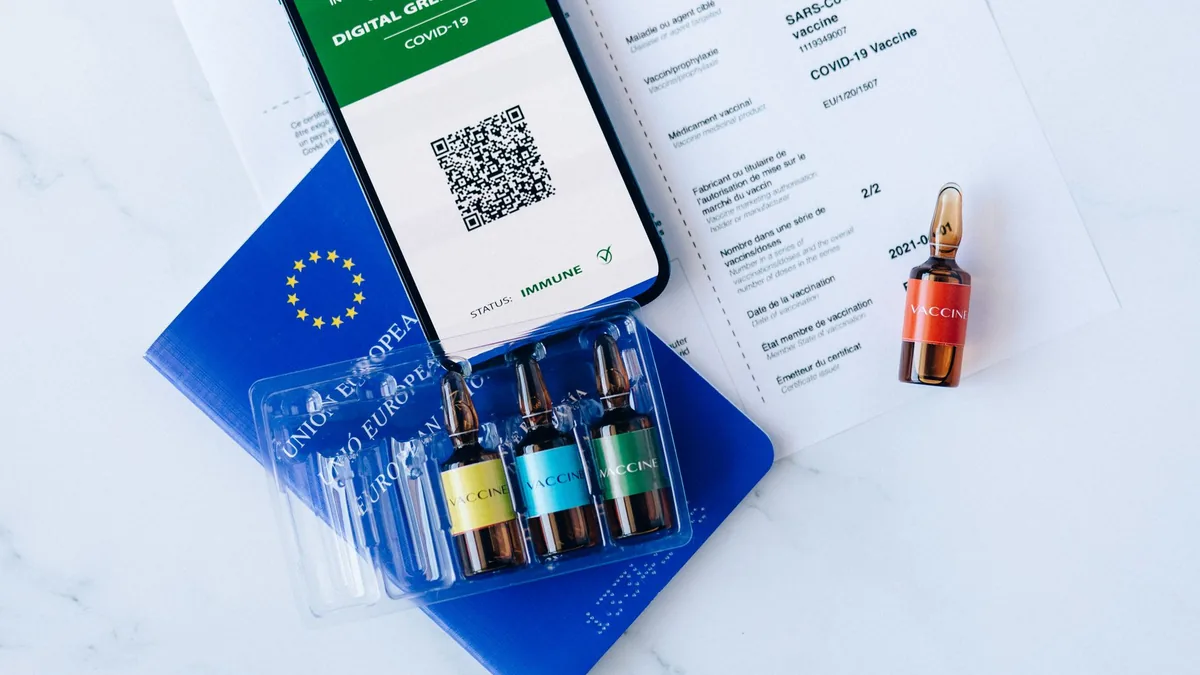
Yes. USCIS accepts vaccination records from your home country once the civil surgeon validates them. Bring each record with a certified English translation. You do not repeat a dose you can prove. For MMR, varicella and hepatitis B, a blood titer showing immunity replaces the shot. A titer is a blood test.
The single most common worry we hear before an immigration medical exam sounds like this: “I was vaccinated as a child in my home country. Will I have to do all of it again?”
Usually, no. But the answer turns fully on one thing. Can your records be validated? That is a paperwork question, not a medical one.
The video above was recorded in July 2025. The COVID-19 point in it is still correct. The CDC Technical Instructions for Civil Surgeons set the vaccination requirements. Those requirements do change. So the age-by-age details below link to our always-updated table instead of being frozen here.
Why are vaccines required for a green card?
This is not the clinic’s choice. It is the law. Under INA 212(a)(1)(A)(ii), an applicant for adjustment of status must show proof of vaccination against certain vaccine-preventable diseases. An applicant who cannot is inadmissible. The statute itself names mumps, measles, rubella, polio, tetanus and diphtheria toxoids, pertussis, Haemophilus influenzae type B, and hepatitis B. It also requires any additional vaccines that CDC has adopted for immigration purposes. These are vaccines recommended by the Advisory Committee on Immunization Practices.
CDC publishes the binding rules in the Technical Instructions for Civil Surgeons. A civil surgeon has no discretion (freedom to choose) to depart from them.
Which vaccines are required for my green card?
This part causes the most confusion, so here it is plainly: the requirements are set by age band. A vaccine that is required for a child may not be required for an adult, and the other way around. What counts is your age on the day of the exam. That age is checked against the current CDC Technical Instructions.
Those bands move. A general list also invites the wrong conclusion. So we keep the current breakdown on its own page instead of repeating it here: Vaccine and immunization requirements for Form I-693. Check your own age band there before you assume a shot applies to you.
Two points from the video apply at any age:
- Seasonal influenza is required only if your exam falls during flu season, September 1 through March 31.
- COVID-19 vaccination is no longer required. USCIS waived it effective January 22, 2025. CDC updated the Technical Instructions on March 11, 2025. If an older guide tells you otherwise, that guide is out of date.
How your existing records are actually validated
Bring everything. That includes records from outside the United States, with a certified English translation. At the exam, the civil surgeon checks each dose on your records against the rule for your age. Then the surgeon names only what is truly missing.
Three things follow from that, and they save applicants real money:
A documented dose counts. You do not repeat a vaccine you can prove you got. The proof is the limit, not the vaccine.
A blood titer can replace a shot. For MMR, varicella and hepatitis B, a titer that shows existing immunity is accepted instead of a new shot. Most applicants do not know this option exists. It is worth asking about when your childhood records are incomplete.
You only need one dose per vaccine at the exam. Some vaccines need a series of doses. Even then, a single dose at the exam satisfies the I-693. You finish the other doses later with your own physician, on the normal schedule.
If you have no records at all, you are not turned away. The civil surgeon records what is required. You can get those doses at our office or at a county health department, often the same week. County health departments are often the lower-cost option.
“Not medically appropriate” is an acceptable answer
Applicants often assume a blank line means a rejected form. It does not. A vaccine may be medically unsafe for you (contraindicated). You may be pregnant. Or it may simply be out of season. In those cases the civil surgeon marks it not medically appropriate on Form I-693. That is a valid, expected entry, not a gap.
What does cause trouble is an undocumented vaccine. That is a dose you believe you got but cannot prove. That is what triggers Requests for Evidence and the delays that come with them.
What this means for your appointment
Vaccines are the part of the I-693 you control most. Testing takes the time it takes. Your paperwork is the part you own. Applicants who arrive with translated records and any past titer results routinely finish in one visit. Those who do not usually need a second. That is why a follow-up visit is a published, separate fee and not a surprise.
Want the bigger picture? To see what else the exam covers and what changed lately, read what changed on the I-693 since 2025.
Related reading: I-693 Exam: What St. Louis Applicants Must Know · May 2026 USCIS Memo and the Green Card Medical Exam
Frequently Asked Questions
Will I have to repeat vaccines I already received in my home country?
Generally no, as long as the records can be validated. Bring the original records with a certified English translation. Each dose on your records is checked against the rule for your age. It is accepted if it qualifies. You only get what is truly missing. Check your age band on vaccine and immunization requirements.
Do I need a blood test instead of a vaccine?
Sometimes, and it can help you. For MMR, varicella and hepatitis B, a titer proving immunity is accepted instead of a new shot. Ask about it if your childhood records are incomplete. The vaccine requirements page lists which vaccines accept a titer.
Is the COVID-19 vaccine still required for a green card?
No. USCIS waived the requirement effective January 22, 2025. CDC updated the Technical Instructions for Civil Surgeons on March 11, 2025. It has not been brought back. Related: the #1 cause of I-693 delays is vaccination gaps.
What if a vaccine is unsafe for me, or I am pregnant?
The civil surgeon records it as not medically appropriate on the form. That is an accepted entry. Never start, stop, or change any medicine or vaccine on your own. Talk about it at the exam. More on how the exam works: Your USCIS Medical Exam Is Not a Physical.
Where do I go, and what does it cost?
The office, hours and directions are on our Clinic Location & Directions page.
Key takeaways
- Records from abroad are accepted when they can be validated. Bring originals plus a certified English translation.
- Requirements are set by age band. Check your band on the vaccine requirements page instead of guessing.
- A titer can stand in for a new shot for MMR, varicella and hepatitis B.
- One dose per vaccine at the exam is enough. Finish any series with your own doctor.
- COVID-19 vaccination has not been required since January 22, 2025.
Watch the full video above, and explore the rest of the series on our YouTube channel.
References
- U.S. Citizenship and Immigration Services. Vaccination Requirements. https://www.uscis.gov/tools/designated-civil-surgeons/vaccination-requirements
- Immigration and Nationality Act § 212(a)(1)(A)(ii); 42 C.F.R. § 34.3.
- Centers for Disease Control and Prevention. Technical Instructions for Civil Surgeons, vaccination component, updated March 11, 2025.
- U.S. Citizenship and Immigration Services. USCIS Waives COVID-19 Vaccination Requirement for Adjustment of Status Applicants, January 22, 2025.
Schedule Your Exam in St. Louis
Schedule Your Exam Text (314) 886-5902 Call (314) 960-9100
Dr. Gurpreet Padda, MD — USCIS-Designated Civil Surgeon (CSID 111051)
4477 Woodson Rd, Suite 102, St. Louis, MO 63134 — minutes from St. Louis Lambert International Airport
🌐 ImmigrationExam.us
🕗 Mon–Wed 8:00am–5:00pm · Thu 8:00am–12:00pm · Closed Friday & federal holidays
💵 I-693 exam $390 · Follow-up visit $190 · N-648 case review $400 (credited toward evaluation) · N-648 evaluation from $1,400
This article is educational information about the immigration medical examination process. It is not legal advice and does not create a physician–patient relationship. For legal questions about your case, consult a licensed immigration attorney.
Medically reviewed by Dr. Gurpreet Singh Padda, MD, MBA, MHP — USCIS-designated civil surgeon (CSID 111051), board certified in Anesthesiology, Pain Medicine, Interventional Pain Management, Addiction Medicine, and Obesity Medicine. Last reviewed October 2026.